 blog
How to Use Online Support in Early Recovery
Last Updated: November 1, 2026
Quick Summary
Online support is good for early recovery when it is fast, frequent, and structured, because early recovery often calls for more contact rather than less. Use it as a bridge alongside in-person or professional care, and vet any group's crisis procedures and confidentiality rules before joining.
- Online sobriety support groups offer free or low-cost access and flexible scheduling around work and family.
- Choose in-person or professional treatment first if you need clinical care, medication, or medical monitoring.
- Ask whether sessions are recorded and what happens if a member discloses a crisis.
- A group that implies it can handle emergencies itself is not safe for early recovery.
- A hybrid plan can combine two in-person meetings, one online group, and a daily check-in.
Table of Contents
- Why Early Recovery Is a Different Support Problem
- Online Sobriety Support Groups: What They Offer and What They Miss
- Online vs. In-Person Addiction Treatment: A Practical Decision Framework
- Recovery Support Apps and Digital Tools That Earn Their Place
- Social Media and Addiction Recovery: Connection Without the Trap
- How to Judge Whether an Online Group Is Safe
- When Online Support Is Not Enough
- Building a Hybrid Plan That Fits Your Week
- Frequently Asked Questions
Why Early Recovery Is a Different Support Problem
Early recovery is the period when the body and brain are still adjusting, triggers hit hard, and a single bad night can undo weeks of work. That is why the question "is online support good for early recovery" matters more than it does later on. The answer is a qualified yes, but only with the right structure.
Early recovery often calls for more contact, not less. Support that is fast, frequent, and available at odd hours can make a real difference.
Later recovery rewards independence. Early recovery rewards presence.
What the Evidence Says About Online Support in Early Recovery
The evidence base is still thin, and anyone who tells you otherwise is overselling. What we can say is that peer support and social support are widely linked to better recovery outcomes. Online formats make that support easier to reach.
A common finding is that engagement drops when access is hard. Online support lowers the barrier. It is not a cure. It is a bridge.
Online Sobriety Support Groups: What They Offer and What They Miss
Online sobriety support groups give you meetings without a drive. They offer low-cost or free access, flexible scheduling, and a recovery community that fits around work and family commitments.
What they miss is presence. A screen cannot walk you home after a hard meeting. Moderation can be uneven, and some forums drift into unhelpful talk.
Peer-based coaching can fill part of that gap because the support is personal and structured.
Online vs. In-Person Addiction Treatment: A Practical Decision Framework
Use this framework to decide, rather than guessing. It is not a rulebook. It is a way to sort your options by what you actually need this week.
- If you need clinical care, medication, or medical monitoring: choose in-person or professional treatment first.
- If you need frequent peer contact and live far from meetings: online support groups work well.
- If you need both: build a hybrid plan. Do not treat it as either/or.
- If you are in crisis: call emergency services. Online support is not a crisis line.
Online vs. in-person addiction treatment is not a contest. It is a matching exercise.
Recovery Support Apps and Digital Tools That Earn Their Place
Recovery support apps help with tracking, reminders, and quick check-ins. They do not replace human contact. Use them for the small stuff so people can handle the big stuff.
- Sobriety counters: simple, useful, and motivating in early days.
- Journaling apps: good for spotting patterns in cravings.
- Podcasts: free, portable, and strong for filling idle time.
- Online forums: helpful for late-night connection, but check moderation.
Digital recovery support works best as a layer, not a foundation. The tool reminds you. A person keeps you accountable.
Social Media and Addiction Recovery: Connection Without the Trap
Social media and addiction recovery can mix, but carefully. The upside is connection and honest stories. The downside is comparison, doomscrolling, and triggers hiding in plain sight.
Set rules before you scroll. Mute accounts that glamorize substance use. Follow recovery-focused creators. Keep your privacy settings tight, because confidentiality matters in early recovery.
A common mistake is treating social media as support. It is background noise. Real support has names, faces, and follow-up.
How to Judge Whether an Online Group Is Safe
Most articles tell you to 'check that a group is safe' and stop there. That is not useful when you are deciding whether to join one this week. Use this as a concrete vetting checklist, and know what a good answer sounds like versus a vague one.
1. Facilitator training and role. Ask who runs the group and what training they have. A good answer names a specific credential or training pathway, for example, a certified peer recovery specialist, a licensed counselor, or a facilitator trained under a recognized peer-support model. A vague answer ('our facilitators are experienced') is a yellow flag. Also ask whether the facilitator is a peer with lived experience, a clinician, or both, the roles are different, and early recovery often benefits from having a clinician reachable when peer support surfaces something clinical.
2. Moderation in practice. Ask how many moderators are present during a meeting and how quickly they respond to a problem. A well-run group can tell you its ratio and its response expectations. A group that says 'members moderate themselves' is telling you that no one is watching when someone posts something harmful at midnight.
3. Confidentiality and privacy rules. A safe group states its confidentiality expectations in writing, what members may repeat outside the group, how recordings are handled (or that there are none), and what happens if someone discloses intent to harm themselves or others. Ask directly: 'Are sessions recorded?' and 'What is your policy if a member discloses a crisis?' If the answers are not documented, assume the protections are informal. Clear protocols regarding personal data provide the necessary foundation for exploring various sobriety alternatives that align with your specific needs during life transitions.
4. Crisis procedures. This is the check most people skip and the one that matters most in early recovery. Ask: 'If someone in this group is in crisis during a meeting, what happens?' A good answer includes a defined escalation, a facilitator trained to respond, a referral to crisis services, and clear messaging that the group is not an emergency line. The 988 Suicide & Crisis Lifeline is the public crisis resource to know; a group that cannot point members to it, or that implies it can handle emergencies itself, is not safe for early recovery.
5. Misinformation and medical claims. Listen for whether the group stays in its lane. Peer support should not be dispensing medication advice, diagnosing, or pushing one treatment philosophy as the only path. A group that tells members to stop prescribed medication, or that dismisses professional treatment, is a red flag regardless of how warm the community feels.
6. Inclusion and fit. Ask whether the group serves your situation, early recovery specifically, your substance or behavior of concern, and your identity or language needs. A general recovery group can be fine, but a group built for people further along may leave an early-recovery member feeling behind or overwhelmed.
A safe group will welcome these questions and answer them without defensiveness. If the answers are vague, evasive, or dismissive, walk away, there are enough well-run options that you do not need to gamble on an unmoderated one.
Use these questions to vet an online group before joining it in early recovery.
| What to check | Good answer sounds like | Warning sign |
|---|---|---|
| Facilitator training and role | Names a specific credential or training pathway | "Our facilitators are experienced" |
| Moderation in practice | States moderator ratio and response expectations | "Members moderate themselves" |
| Confidentiality and privacy rules | Written policy on repeats, recordings, disclosures | Protections are undocumented and informal |
| Crisis procedures | Defined escalation, referral to crisis services, 988 Lifeline | Implies the group can handle emergencies itself |
| Misinformation and medical claims | Stays in its lane, no medication advice | Tells members to stop prescribed medication |
| Inclusion and fit | Serves early recovery and your situation | Built for people further along |
When Online Support Is Not Enough
Online support is not enough when cravings spike at night, when isolation deepens, or when substance use returns. That is not failure. It is a signal that you need more contact, not less.
If a gap hits late, practical steps for those hard hours can help. For many people, the next step is professional coaching or treatment, and it is worth asking directly rather than waiting. You can contact us today to ask about coaching or treatment options. You can contact us to talk through coaching options.
The federal resource on finding treatment is a good starting point for local care.
Building a Hybrid Plan That Fits Your Week
A hybrid plan combines in-person and online options so support fits around everyday life. The aim is contact you can keep, not a perfect schedule. A concrete template for how to create a recovery plan that actually works can help you draft it.
- Two in-person meetings for presence and accountability.
- One online group for midweek contact.
- A daily check-in with a peer or coach.
- A weekend review to spot triggers and adjust.
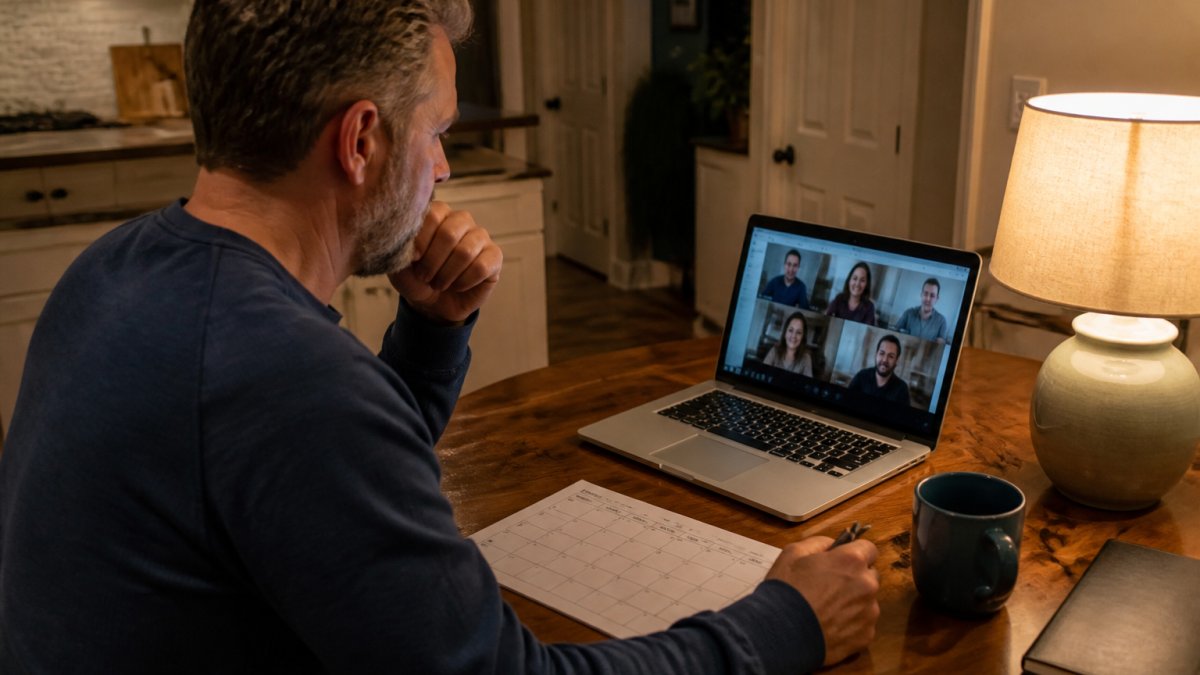
Support has to survive a bad Tuesday. Build the plan around that.
Frequently Asked Questions
Is online support effective for addiction recovery?
Research on digital recovery support generally finds that people who engage with online groups, apps, and peer forums report better engagement and retention than those who rely on in-person options alone, largely because access is easier. The evidence is strongest for peer connection and relapse prevention support, and weaker for replacing structured clinical treatment. For early recovery, treat online support as a way to increase how often you get help, not as a substitute for professional care when withdrawal risk or a co-occurring condition is present.
What are the risks of online sobriety support groups?
The main risks are unmoderated spaces where misinformation or drug-seeking talk goes unchecked, privacy leaks if you share identifying details in a public forum, and the false comfort of joining a group without ever speaking up. Groups without trained facilitators can also drift into advice-giving that sounds clinical but is not. Before joining, ask who moderates the space, what the rules are, and whether the platform lets you stay anonymous. If a group pressures you to skip professional treatment, leave it.
Can I use online support alongside addiction treatment?
Yes, and that combination is usually the strongest setup in early recovery. Keep your clinical appointments, medication, or counseling as the backbone, then add online support groups, recovery support apps, and peer check-ins for the hours between sessions. The practical benefit is coverage: a craving at 2 a.m. is not something a weekly appointment can address, but a moderated forum or a peer call can. Tell your treatment provider what you are using so they can flag anything that conflicts with your plan.
How do I find a safe and reliable online recovery group?
Look for three things: a named moderator or trained facilitator, published group guidelines covering confidentiality and respectful conduct, and a clear statement of what the group is and is not (peer support versus clinical care). Sit in on a session before committing and note whether people are listened to or talked over. Free, low-threshold options are widely available, so cost is not a reliable signal of quality. If the group feels like a sales funnel for one person's program, keep looking.
Early recovery is hard enough without guessing where to turn. RBM Professional Services offers compassionate, people-first coaching grounded in lived experience, including insights from A Second Chance. We can help you build a plan that fits your week and stays with you. Get started with RBM Professional Services and take your next step with support that does not judge.