 how-to
How to Rebuild Trust After Addiction: A Step-by-Step Guide
Table of Contents
- Why Rebuilding Trust After Addiction Requires Intentional Action
- Step 1: Acknowledge the Harm and Take Full Responsibility
- Step 2: Apologizing to Loved Ones After Addiction
- Step 3: Communicate Openly and Honestly About Your Recovery
- Step 4: Setting Boundaries in Addiction Recovery
- Step 5: Keep Your Word and Follow Through Consistently
- How Long It Takes to Rebuild Trust After Addiction and What Progress Looks Like
- Rebuilding Relationships After Addiction: When Reconciliation May Not Be Appropriate
- Frequently Asked Questions
Last Updated: October 14, 2026
Why Rebuilding Trust After Addiction Requires Intentional Action
Broken trust is one of the hardest consequences of addiction. Your loved ones watched you struggle and felt the hurt firsthand.
RBM Professional Services works with people in recovery and their families. Rebuilding trust after addiction isn't about grand gestures or perfect apologies. It's about consistent, small actions over time.
The truth is simple but demanding: trust is rebuilt through behavior, not words. Your loved ones need to see change and feel safe around you again. That takes intentional effort, patience, and a willingness to be uncomfortable.
This guide walks you through the concrete steps to rebuild trust after addiction: acknowledging harm, apologizing sincerely, communicating openly, setting healthy boundaries, and following through consistently. We'll also cover realistic timelines and what progress looks like.
Step 1: Acknowledge the Harm and Take Full Responsibility
You can't rebuild trust without first acknowledging what you broke. That means naming the specific harm you caused, not vague apologies like "I'm sorry if I hurt you."
Think about the concrete ways your addiction affected your loved ones:
- Did you miss important events? Birthdays, graduations, holidays?
- Did you break promises repeatedly?
- Did you lie to cover up your use?
- Did you create financial stress or instability?
- Did you put them in unsafe situations?
- Did you make them feel responsible for your recovery?
Write these down, then tell the people you hurt exactly what you did. Use real details: say "I missed your graduation because I was using" instead of "I wasn't there for you."
Taking responsibility means no excuses. You don't say "My disease made me do it." You say "I made choices that hurt you. I'm responsible for that."
This is uncomfortable, and it should be. Sitting with that discomfort shows your loved ones you're willing to feel bad for what you did.
Step 2: Apologizing to Loved Ones After Addiction
A real apology has three parts. It's not just saying sorry.
First, express genuine remorse. Show that you understand the impact of what you did emotionally, not just intellectually.
Second, commit to change. Tell them specifically what you're doing differently now.
Third, ask what they need from you going forward. This is the part most people skip, but it's crucial. Ask them, listen without defending yourself, then actually do what they ask.
Here's what a real apology sounds like:
"I'm sorry for lying to you about my use. I know that made you feel unsafe in our home. I know you stopped trusting me because I kept breaking my word. I understand how much that hurt you. I'm now going to therapy every Tuesday and Thursday, and I'm working with a sponsor who I check in with daily. I'm also going to be completely honest with you about where I am and who I'm with. I know trust takes time to rebuild. What do you need from me right now to start feeling safer?"
Notice what's missing: no "but," no "I was sick," no "I didn't mean to." Just clear acknowledgment, specific action, and an invitation to share what they need.
Step 3: Communicate Openly and Honestly About Your Recovery
Open communication is the foundation for rebuilding trust after addiction. But it has to be real communication, not just talking.
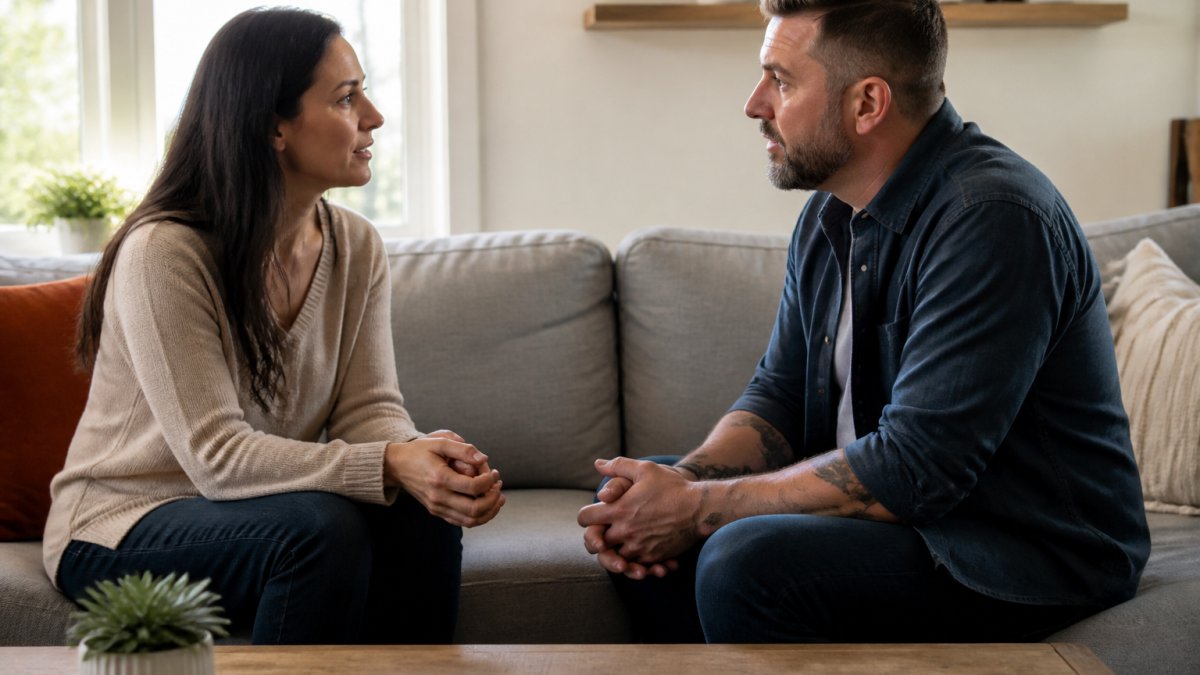
Real communication means sharing what's actually happening in your recovery. Talk about cravings, mention when you're struggling, and don't hide the hard parts. Your loved ones need the real story.
Set up regular check-ins. Weekly is better than daily (which can feel like surveillance) but more frequent than monthly (which loses momentum). During these check-ins, talk about:
- How your recovery is going
- What triggered you this week
- What you're doing to stay sober
- How you're feeling emotionally
- What support you need from them
Your loved ones should also get to share. Ask how they're doing, whether they feel safe, and what worries them, and listen without getting defensive.
Here's what intentional communication looks like in practice:
- You say "I had a really hard day at work and I wanted to use. I didn't, but I called my sponsor and we talked for 20 minutes. I'm doing okay now."
- You don't say "Work was fine" and then hide the struggle.
- You say "I'm nervous about seeing my old friends next week. I'm going to avoid that situation entirely."
- You don't say "Everything's great" and then disappear for hours with no explanation.
Honesty builds trust; hiding things destroys it. Your loved ones would rather hear you're struggling than find out later you were lying.
Step 4: Setting Boundaries in Addiction Recovery
Healthy boundaries protect your recovery and your relationships, and they show your loved ones you're taking sobriety seriously.
Some boundaries protect you: avoiding people, places, or situations that trigger cravings, saying no to events with drugs or alcohol, or stopping calls after 9 PM to focus on sleep.
Other boundaries respect your loved ones' needs. They might need space, might not be ready to spend time alone with you, or might need you to check in before coming over.
Setting boundaries means you communicate them clearly:
- "I'm not going to that party because there will be drinking. I know that might feel limiting, but it's what I need for my recovery."
- "I need to be home by 9 PM on weeknights. That's when I do my reflection and prepare for the next day."
- "I understand you're not ready to have me over for dinner yet. I respect that. Let me know when you are."
- "I'm going to call you on Wednesdays at 6 PM. That's our check-in time."
The key is boundaries that support your recovery without isolating you or avoiding accountability. Real boundaries are specific and time-bound, temporary structures, not permanent walls.
Your loved ones need to see you protecting your sobriety fiercely. That shows them you're serious about change.
Step 5: Keep Your Word and Follow Through Consistently
This is where most people fail: they make promises and don't keep them.
Keeping your word is how you rebuild trust after addiction, not through big dramatic moments, but small, consistent actions. You say you'll call Wednesday at 6 PM, you call at 5:55 PM.
Your loved ones have heard promises before, to get clean, go to treatment, change, and watched them break. Now they're skeptical, and they should be.
Here's what consistency looks like:
| Action | Commitment | What It Proves |
|---|---|---|
| Attend meetings | Three per week, every week | You're serious about recovery |
| Check-ins | Same time, same day, every week | You're reliable and organized |
| Therapy appointments | Show up on time, every session | You're invested in healing |
| Being honest | Tell the truth even when difficult | You've changed your relationship with honesty |
| Respecting boundaries | Follow through on what you said | You can be trusted |
Start small and don't commit to things you can't do. If you say you'll call every day, call every single day. Your loved ones are watching and hoping you'll follow through.
When you slip up, acknowledge it immediately. Don't hide it or make excuses. Say "I missed our check-in on Wednesday. That was wrong.
How Long It Takes to Rebuild Trust After Addiction and What Progress Looks Like
There's no fixed timeline for rebuilding trust after addiction, but there are signs that progress is happening.
Early progress (first 3-6 months):
- Your loved ones stop flinching when you walk in the room
- They start answering your calls
- They believe you when you say you're going to a meeting
- They notice you're following through on small commitments
Mid-stage progress (6-12 months):
- They initiate contact with you
- They start sharing things about their own lives
- They ask about your recovery without suspicion
- They introduce you to their friends or family members again
Longer-term progress (1-2 years):
- They invite you to family events
- They let their guard down around you
- They believe you're genuinely changed
- They're willing to be vulnerable with you again
Some relationships take years to fully heal, and some never return to what they were. That's not failure, that's reality. You hurt people deeply, and healing takes time.
What matters is that you see movement: them becoming less guarded, willing to spend time with you, and believing in your recovery.
Watch for these signs that you're making progress:
- Fewer questions about where you are and who you're with
- More genuine laughter when you're together
- Them bringing up memories from before your addiction
- Them expressing pride in your recovery efforts
- Them trusting you with something important
If you're not seeing progress after 6-12 months of consistent effort, something needs to change. Maybe you need different therapy, more transparency, or to ask your loved ones directly what they need from you.
Rebuilding Relationships After Addiction: When Reconciliation May Not Be Appropriate
Here's the hard truth: sometimes rebuilding trust after addiction isn't the right goal. Sometimes reconciliation isn't appropriate or safe.
If someone has repeatedly stated that they don't want a relationship with you, respect that.
If staying in contact with someone enables your relapse, you need to stay away. Your recovery comes first.
The goal isn't reconciliation with everyone. The goal is healing. Sometimes healing means rebuilding trust.
If you're unsure whether to rebuild a relationship, talk to your therapist or sponsor.
Recovery is about becoming the person you want to be. Sometimes that means rebuilding trust after addiction.
Rebuilding trust after addiction is hard, slow work.
But it's possible.
If you're struggling with how to navigate this process, RBM Professional Services offers coaching and support specifically designed for people in recovery and their families. RBM Professional Services, rooted in lived experience with addiction recovery, can help you work through the specific challenges in your relationships and create a plan for rebuilding trust that works for your situation.
Frequently Asked Questions
How long does it actually take to rebuild trust after addiction?
Rebuilding trust is not linear. Some relationships show measurable progress within 3-6 months of consistent sobriety and behavior change, while deeper trust may take 1-2 years or longer. Progress depends on the severity of harm caused, the consistency of your recovery actions, and your loved one's capacity to forgive. Watch for signs like reduced suspicion, more open conversations, and willingness to spend time together. Patience and realistic expectations are essential, trust is rebuilt through repeated small actions, not grand gestures.
What should I say when apologizing to loved ones after addiction?
A genuine apology names the specific harm you caused, acknowledges their pain without making excuses, and commits to concrete change. Say: 'I hurt you by [specific behavior]. I know that caused you [specific impact]. That was wrong, and I take full responsibility. Here's what I'm doing differently now [specific actions].' Avoid 'I'm sorry if you were hurt' or 'I was sick, so I couldn't help it.' Focus on their experience, not your struggle. Then follow through, your actions matter far more than your words.
How do I know if someone is ready to rebuild the relationship with me?
Signs someone is ready include: they're willing to have conversations about your recovery, they ask questions about your treatment or support, they spend time with you without constant suspicion, and they express hope about your future. However, readiness varies. Some people need more time; others may never be ready, especially if the harm was severe. Respect their timeline. If they're not ready, continue your recovery work anyway, for yourself and to leave the door open. Professional support, like therapy or coaching, can help you navigate rejection while staying committed to sobriety.
What if I slip or relapse, how do I rebuild trust again?
A slip or relapse is a setback, not a failure of your entire recovery. Immediately acknowledge it to your loved ones, don't hide it. Explain what triggered it, what you're doing differently now, and recommit to your support system (treatment, meetings, sponsor, therapy). Your loved ones may feel betrayed; validate that. Rebuilding trust after a setback takes longer, but it's possible if you respond with honesty and renewed commitment. This is where consistency and follow-through become even more critical. Many people rebuild trust stronger after managing a setback well.